Compared to its predecessor Ritchie Blackmore's Rainbow, Rising cranks it all up to eleven: the sword and sorcery, the heaviness, the complexity and length of the songs, the instrumental performances - it is basically the quintessential record of the Dio-era. Did the first album sound like the band was dipping their toe into a new world of hard guitar-centered music, in Rising they jumped fully into it.
Probably the best example is the epic Stargazer. Everything is larger than life in this song. A miniature-opera about the rise and (quite literal) fall of a wizard who enslaved the people to build him a tower to the stars. The way guitar and vocals are dramatizing the story here works so well and expressive and organic, with both being at the peak of their abilities, that its a pure, uplifting joy listening to.
Might the rest of the album not quite have the same epic dimension, with predominantly fast-paced songs, it is nevertheless spectacular. A good part of this is due to Cozy Powell's dense and varied drumming, which ties the songs together and works as a perfect counterpoint to the stunning performances of the albums main actors, Blackmore and Dio.
I think in hindsight you can see how influential Rising was to 80's metal: The breakneck guitar shredding, the fantasy-centered cover artwork and lyrics, delivered by an almost operatic vocalist and the occasional keyboard flavouring - all these bits became commonplaces in the decade after.
Its just a shame that the band initially wasn't too successful. About five years later, when the world was finally ready for this type of music and bands like Iron Maiden and Manowar filled the venues playing quite similar material, Blackmore had pushed Rainbow into radio-friendly territories instead. Luckily for us, Dio kept on waving the heavy-metal banner high. First with Black Sabbath and later as solo-artist with his own band.
All in all, Rising is definitely a milestone in the evolution of metal and an underrated masterpiece. And even the cover is less eye-watering than the first one!
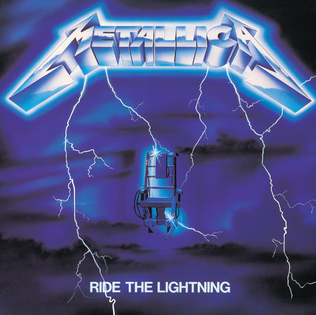
I have a bit of a love/hate relationship to Metallica. On the one hand, I really like their albums from the 80s, on the other hand, I find they didn't really do anything relevant, or even noteworthy in the last 20-something years. But that's not our topic for today! Ride the Lightning is one of their records I really love. After a promising and already technically quite impressive, if a bit too simple debut-album, Kill 'Em All from 1983, Ride the Lighting is an enormous leap forward.
Before it came to that though, Metallica went through quite turbulent times. Namely rising tensions with their original vocalist/guitarist Dave Mustaine, over his violent behaviour and his drug and alcohol consume. This escalated in him being sacked from the band just before recording Kill 'Em All. As a consequence, Mustaine, while not actually playing on the album, got song writing credits on a number of tracks of their first and second album. including the eponymous Ride the Lightning and Call of Ktulu.
Mustaine went on and formed Megadeth, and Metallica found its identity in with Kirk Hammett as new lead guitarist, James Hetfield growing into his roles as vocalist and rhythm guitarist, Cliff Burton on bass and Lars Ulrich on drums. Together both bands became two of the most influential metal bands and biggest rivals of the 80s.
Were changes in tempo and dynamic not a completely new thing in rock/metal, when Ride the Lightning came out, (Led Zeppelin and Black Sabbath were doing that sort of thing more than a decade before), the way how consequentially Metallica was contrasting clean, almost folky passages with their speed and heavy, brutal riffing to build up a narrative within a song, proved to become highly influential for the genre. Technical excellence is one thing - and there is plenty of that on Ride the Lightning as well - but if you can tell a story with your music, and have some emotional impact, or at least give them time to breathe before the next full-on assault, you can catch your audiences attention on a completely new level.
And the album is bursting with great ideas and songs. May it be thrashers like Fight Fire with Fire or Creeping Death, epic narratives like For Whom The Bell Tolls orFade to Black, or the brilliant instrumentalThe Call of Ktulu or the breakneck-speed ride Trapped Under Ice - they all show a masterful level of catchy songwriting, variety and spot on instrumental performances. It is no surprise that this album is still some of their most known and liked ones and part of what defined metal in the 80s.
His stints at Rainbow and Black Sabbath catapulted the unknown singer Ronnie James Dio (born Ronald James Padavona), of the unknown rockband Elf up at the Mount Olympus of hardrock and heavy metal. After leaving Sabbath in 1982, he formed his own group the following year. Conveniently named Dio, after himself. And probably to ensure this time there are no doubts about who is its leader.
The new band basically picked up where he stopped. With straightforward fantasy-inspired heavy metal as it would become archetypical for the 1980s. Unlike the guitar-dominated sound of Sabbath or Rainbow though, with more emphasis on the vocals. And rightly so: Ronnie James Dio's voice is as distinctive as it is powerful. Together with Judas Priest's Rob Halford, he probably was the metal vocalist of the 80s. A singer you would recognize amongst thousands. So dynamic and yes, almost operatic in its range and power. Always giving that little extra emphasis, that is needed for proper heavy metal theatrics. He could sing your shopping list and make it sound like an tolkienesque-epic.
As brilliant as his voice was though, it would have been a waste if the other musicians weren't up to their task. And hell, they are. Guitarist Vivian Campbell's playing is in every sense a proper substitute for Ritchie Blackmore or Toni Iommi, without the danger of mimicry, and the rhythm-section, including Jimmy Bain on bass and drummer Vinnie Appice, who he snatched from Black Sabbath (where they recorded Mob Rules together), delivers a seemingly effortlessly brilliant performance. The whole album just marches ahead with straightforward classic heavy metal. Every fill, every riff and every solo spot on. Holy Diver feels like the band is playing together for a long time already. No surprise that quite a number of songs, like Holy Diver, Don't Talk to Strangers, Straight Through Your Heart and Rainbow in the Dark, became live-staples and are now regarded as heavy metal classics.
Musically, Holy Diver is of course not the most diverse of all records. It pretty much does what its cover-art promises. Well. not literally. Though, that would be quite something... Anyway. if you expect introvert subtlety, then you might have misunderstood the whole concept of heavy metal in the first place!
All in all, Holy Diver is epic 80's heavy metal at its finest and truly a must-know-album, that helped defining the genre. The band in this line-up would record two more albums, The Last in Line (1984) and Sacred Heart (1985), before descending into power struggles and instability. To me, these three albums mark the highlight of the band. Later albums still have their moments, but won't offer such an abundance of consistently strong material.
Deep Purple was never free of conflicts. At least not for long. Strong egos, touring stress, diverging creative ideas and their rocketing success in the early 70s with all its consequences (as in drugs, more touring stress and ever bigger egos) - that's all not really de-escalating factors. Ironically, their most creative (and successful) line-up is at the same time the one which probably was the most tense. Of course we are talking about what is known as Deep Purple Mk.II. Originators of masterful albums like In Rock (1970), Fireball (1971) and Machine Head (1972).
With the (involuntarily) departure of Ian Gillan and Roger Glover on the peak of the band's success in 1973 and Blackmore leaving two years later (frustrated, but voluntarily), Deep Purple went into a steady decline and eventually - in 1976 hit rock bottom and fell apart unceremoniously.
In the years afterwards, each member went on to boldly pursue his own projects he never had time for while being in Deep Purple. Well... not really. Jon Lord and Ian Paice found themselves playing several years together in Whitesnake, the band of Gillan's replacement, David Coverdale, which - at least in Lord's case - was more a vacational arrangement than anything else. Roger Glover eventually joined Ritchie Blackmore's Rainbow in its commercial successful radio-rock, post-Dio-phase. Only Ian Gillan was really doing solo-projects (amongst with losing a lot of money in bad investments).
Anyway, at least in retrospect it seems they couldn't really stay away from each other for too long, doesn't it? So in 1984 their reunion eventually happened. Having big cheques waved at them by their record company certainly helped a bit as well.
But enough of the foreplay. How well does the record actually hold up, I hear you ask? Ok, since you ask me so directly: Its amazing!
The album starts off subtly with a sneaky keyboard-intro before building up to the groovy and relaxed rocker Knocking at Your Back Door. Already at this point you know, this is going to be good. All the ingredients which make Deep Purple what it is are back together in perfect harmony. Those typical Blackmore guitar-riffs and melodies, the unmistakable and elegant keyboard by Jon Lord, always there when you need it, but never pushing itself into the spotlight for the sake of it, the powerful Glover/Paice rhythm engine and those sleazy Gillan vocals (really, listen to those lyrics!) that fit to the sound of the rest of the ensemble so brilliantly that it's hard to imagine anybody else doing the job (well, certainly not Coverdale/Hughes).
For the second track, Under the Gun, the band is shifting up a couple gears. A tense and energetic song that wipes away all remaining doubts whether they still had their fire. With its simple, but superbly effective intro riff (in great symbiosis once again with the keys-section) it storms over you and takes you with it before you figured out what happened. Great song. One of my all-time favourites.
Nobody's Home and Mean Streak are similarly energetic and fast rockers and certainly excellent songs in their own right, but the monumental Perfect Strangers following them just steals the show here. What a song! Heavy and almost gothic in its dark and cold mood. Probably the archetypical Deep Purple song of the 80s and always a highlight played live.
After the moderately-paced epic named Perfect Strangers, A Gypsy's Kiss is picking up the tempo again and rushes through its classical-inspired melodies with breakneck-speed. I always associate it with rushing along a nightly road or through a tunnel. It just has this rushing, tunnel-vision-feel to it. Really captivating.
Wasted Sunsets, on the other hand, is musically the complete opposite. Slow-paced and melancholicly meandering, with some of the most beautiful guitar soloing you might encounter in a long while. So lyrical, so intense and heartbreakingly played. An absolutely brilliant song.
The album finishes (in the LP version) on a bit of a sentimental note with Hungry Daze. A restless rushing through scenes of their busy tour life - the aforementioned hungry days, when they were almost constantly either on the road or recording a new album. A good song with some blistering guitar-work once again.
The final final track is Not Responsible, which stomps along quite nicely but doesn't really goes anywhere. Not a bad song. Certainly not, but in company with all the greats on this record, it falls off a bit. At least it give you some additional four minutes to enjoy this brilliant, perfectly attuned band, before it fades out.
Sound-wise Perfect Strangers picks up on their album Machine Head and does a modernised interpretation on the crisp, cold and almost biting feel it had. This modernisation works really well and at no time like an artificial ahem... "enhancement", of albums like Yes' 90125 with its silly, seemingly randomly thrown in samples. Blackmore allegedly told his band mates to listen to it carefully for inspiration. Good job they paid attention to the right parts. Because you can doesn't means you should do certain things!
The production by Roger Glover on the other hand, who did a lot of Deep Purple-albums over time, is solid, but a bit too muddy. Other albums from around this time are clearer, punchier, so no chance of blaming 80s studio-technology there.
So despite the slight niggle here and there, which is like complaining that in the Himalaya not all mountains are the same, height, my verdict remains. Perfect Strangers is amazing. A spectacular reunion-album with sparks flying left and right and the good old Deep Purple motor firing happily from all its cylinders. As usual with this line-up, the peace didn't last forever (or longer than a couple of months!), but at least we got this wonderful album out of it.
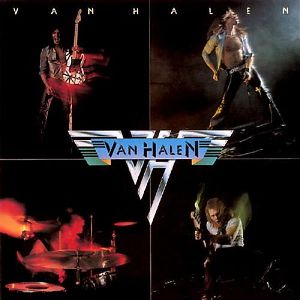
It's probably fair to say that this album started the 80s. At least when it comes to hard rock/heavy metal. Such energetic songs, the top-of-the-line production and, most critically, Eddie van Halen's groundbreaking guitar.
He is often described as the one who brought tapping to the electric guitar, but while its certainly a spectacular technique, I actually rate his characteristic sound (the so-called "brown tone", the blueprint for the 80s-typical high gain) and his masterful use of the instrument in the context of the songs actually as his bigger achievement.
Like Jimi Hendrix ten years before him, van Halen's playing blends rhythm and melody together so naturally, so skilfully that its just sheer exciting joy to hear these songs. So much talent, yet so much tasteful playing for the songs and not for the sake of virtuosity (well, most of the time).
Ain't Talkin' 'bout Love is a perfect example for that. It kicks off with this brilliant riff (its a bit overused maybe, but that's not the riff's fault!), which still sounds modern despite being recorded 40 years ago. Same applies for the Kinks-cover You Really Got Me, which feels like a natural evolution of the original song. After all, the Kinks where amongst the first who experimented with distorted sounds. Namely on this very song, so there is that.
Eruption, on the other hand, is a different animal altogether. I remember when I listened to it for the first time and it sounded so futuristic. Like the guitar turned into a synthesizer in some parts - brilliant!
Of course its pure technique-wanking, lets be straight about that. A highly skilfully played tapping demo and it can't hide its nature, despite being played with a lot of melody and taste. It therefore sounds a little dated today. Tapping is not as revolutionary anymore and shredding became commonplace really. Or - even worse - something like a sport.
Therefore, Eruption feels to me now like a magician's trick when you find out how he did it: the sense of wonder simply has worn off a bit.
This doesn't stops being Van Halen's first from being a outstanding, game changing record and really fun to listen. The duo Eddie Van Halen (guitar, of course) and David Lee Roth (vocals) works together so congenially and turns the album into a damn good party.
Lyrically the album ticks all the boxes of sleazy cock-rock. But you don't listen to Van Halen because you expect something meaningful or even poetic, so don't expect to get it.
All in all, its a spectacular record. Probably one of the best debut albums of all time. Technically and musically it is still brilliant and quite timeless. The only weak spots are the shallow and sleazy lyrics really, but with that Van Halen are in excellent company.
How deep can you fall? The song says damn deep. If it wasn't the remnant, the rotten body of the amazing Jefferson Airplane, It could be a decent off the shelf 80's hit. But being what it is, it is a tragic comedy.



.jpg)